
submitted by Horst Wolff and Julia Shovein
An alumnus of Baja Haha 2007 and the Puddle Jump 2008, Pacific Star continues to circumnavigate and arrived in London this past October where she remains for the winter. We crossed the Indian Ocean, the Gulf of Aden, and the Red Sea in 2010, traveled up the Greek Islands, through the Dardanelles, across the Sea of Mamara and then wintered in Finike, Turkey after sailing south from Istanbul. We came home to Paradise, CA for some R&R and in February got the horrible news about the murders onboard the Quest and the kidnapping of the family aboard ING. During this time we received frantic, fear-filled emails from those on their way to Oman. Scorpio, a Finnish sailing vessel, wrote us from the Maldives that they had decided to turn around and return to Thailand. Marguarita, a Danish cruiser, wrote that their good friends on ING had been taken hostage but they decided to go ahead and motor-sail as rapidly as possible through the danger area and up the middle of the Red Sea. Cyan, an American boat, also decided to proceed but said many of the vessels they left in Oman were waiting for a freighter that would transport the boats to Europe for $20,000/vessel.
We returned to Finike in March and were greeted by many of the cruisers who had remained there throughout the winter. We sat around the cruisers’ clubhouse amid barbecues, games, and music making and discussed plans, navigational routes, and visa problems for those non-EU boats like us in traveling to Schengen agreement countries. In April we made the four-day passage to Crete. We spent almost a month on this beautiful Greek Island at Agios Nicholaos and Spinalonga. There were dozens of British boats that had wintered here and we were warmly welcomed and participated in their organized walks and fun at their clubhouse. We shared a car rental so that we could explore the whole island. Unlike the other Greek islands, there seemed to be no expectation that we would check-in officially or obtain a cruising permit. We took advantage of the independent Crete feeling of not quite being part of Greece to avoid our official EU check-in. (Officially a non-EU boat can stay in Europe for 18 months without paying the Value Added Tax of 20% of vessel value but the occupants of the boat can only stay in Europe for 90 days within a six- month time period.)
We sailed in gale force winds Force 8 and 9 (not in the forecast) rounding the southern coast of the Peloponnese on our way from Crete to Ithaca. Our autopilot could not handle the huge, steep sea so we hand-steered under double reefed main and staysail. We had been warned about taking this notoriously windy route as most sailors preferred to cut through the Peloponnese using the Corinth Canal. We did not regret our decision as we marveled at the wildly rugged beauty of this little travelled part of the Med. Along the way we anchored in beautiful, small, sheltered bays among the myriad of Greek islands. We were constantly reminded of the stories of Odysseus and Jason and the Argonauts as ancient names on the charts were the same as in the old tales. We sailed across the Ionian Sea from Ithaca to Santa Maria di Leuca, the tip of the heel of the boot of Italy. We had arrived in the Puglia region of Italy and never have we eaten such wonderful food. The first thing we noticed was that as Greece had been more expensive than Turkey, Italy was more expensive than Greece. Italian marinas were not nearly as good as those in Turkey, but the prices were really high ranging from 40 euros per night in Puglia to 240 euros per night on the island of Capri near Naples. We met many cruisers in Italy who gladly gave us advice about anchorages and cheaper hard-to-find marinas. In Rocella Ionica we met an Australian couple and an American couple who had been in the Mediterranean for years (eight and four respectively) and they shared advice about where to go, how to obtain the Constitudo (an Italian cruising permit that most ports want nothing to do with but if you go to Elba are fined 200 euros if you do not have it) and how to avoid the VAT (leave the EU every 18 months for a few weeks), and how to avoid visa problems (keep a low profile and be nice to everyone).
We rounded the southern tip of Italy and moved up the Messina Straight passing Scylla and Charybdis on our way up the western coast. In Bagnara Calabra we were welcomed in New York-accented English by the marina worker. Everyone in this small town has relatives in New York and as Americans we were given every courtesy and kindness (and a hefty marina discount). Onward to the fireworks of Stromboli, the two hundred steps of Tropea, and the fantastic Amalfi Coast where we noticed the sailboat from San Francisco became part of the tour boats’ spiel.
In Rome we stayed in the Fiumicino Canal at the Constellation Nautica Marina amid the fishing vessels of this working town. There were 26 cruisers rafted up three abreast. Just outside the marina gate was the bus stop for the quick bus ride to the Rome metro. We stayed a month (total cost 240 euros) and explored Rome each day. We made some wonderful friends among the cruisers. One night at dinner on Safari, an Irish vessel, we met an Italian cruiser who was a conductor (symphony not train) who had sold his Rome apartment to live on his boat. “I told my agent I will only perform in cities where I can arrive by sea.” He says he gets some funny looks leaving his boat to go to work in his tuxedo.
Making our way north we spent more than a week in Elba, a gorgeous island with numerous picturesque anchorages. Napoleon escaped this beautiful place after a short time in exile. From here we sailed to La Grazie, Tuscany where we took a short train ride to do the most drop-dead-gorgeous coastal hike in the world – the Cinque Terre National Park Walk.
We left La Grazie for San Remo on an overnight passage that should have been uneventful. However, the Med can be obstinately quiet with no wind or the opposite with very high, steep, choppy seas. When high the seas are often quite confused due to the wind direction, current and unique landmasses. The Mistral had been blowing down the Rhone Delta for three weeks at 20 – 30 knots but according to the forecast it had pretty much blown out. Visitors waiting for us in San Remo contributed to our poor decision to leave a day earlier than we should have as the waves were still quite big and we had to go to weather. I broke my arm when I was thrown across the salon. Horst thought our trip was over at this point and was trying to figure out how to get me home and sell the boat. He notified the Italian Coast Guard and they came out to guide us into San Remo and they had an ambulance waiting. I got great care at the Italian hospital and ended up in a restraining brace on my arm and shoulder for 6 weeks and required no surgery. I was good to go.
Next stop Port St. Louis, France where we had our mast unstepped because our air drought was not to exceed 2m (6.6 feet). The bubble-wrapped mast was shipped north by truck to Rouen while we motored for 1000 miles through the French canals. Our Island Packet needs 1.5 m (5 feet) of water depth, just enough to make it through the canals. We bought bikes so we could get around when arriving at a new village each afternoon. We would usually find a dock or town quay or sometimes just drive stakes into the shore side to tie up. One village had a barbecue in our honor the evening we arrived because we were the first US vessel to stop there. The French people were especially welcoming to Americans and we couldn’t get over the friendliness we experienced. The countryside was gorgeous with castles and cathedrals dotting the landscape, picturesque villages tucked into the countryside, a true fairyland. We worked hard going through the locks doing as many as 28 locks one day. It was exhausting. When we finally arrived at Arsenal Marina in the center of Paris, we had 10 relaxing days of just being tourists. In Rouen we passed through the final lock to enter the tidal Seine. The mast was restepped as we now had adequate bridge clearances and we headed at 10 knots/hr down to Honfleur at the confluence of the Seine and English Channel, taking advantage of the huge outgoing tide. From this beautiful town we explored the Normandy Beaches visiting the American Cemetery where acres of white crosses indicate where so many young soldiers are buried.
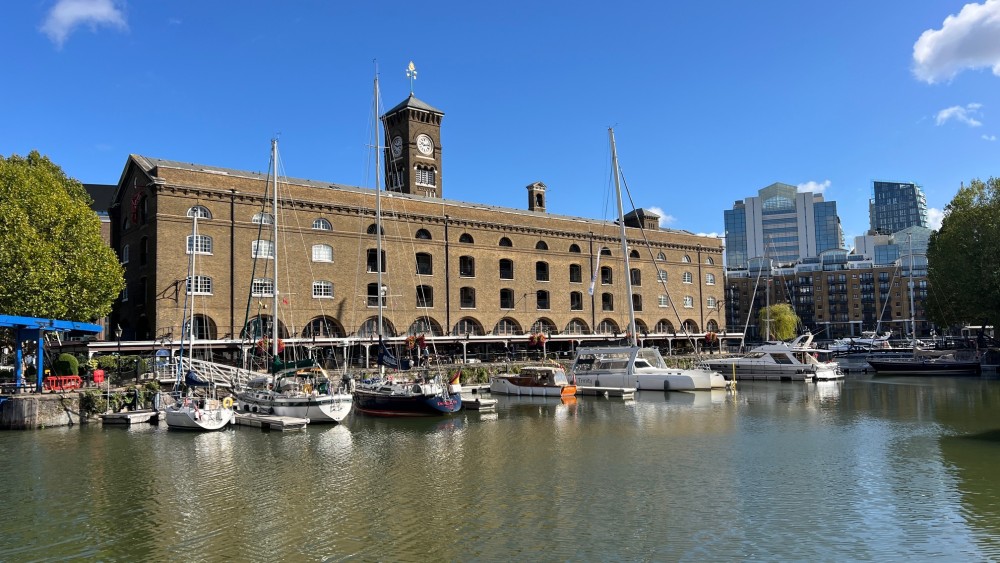
We had a fast and uneventful English Channel crossing and we were right on schedule to arrive at our final winter destination by the middle of October to avoid the winter storms. We arrived in Ramsgate to have our lines received by two old English friends I had not seen in 39 years (thanks to Google). They brought a bottle of Champagne and fluted crystal glasses to celebrate our arrival. We had arrived on an island where sailors are truly appreciated. Now for the first time in our travels we had to negotiate 24 feet tides and the incredible currents that go with it. We made our way up the Thames Estuary riding the tide past the Thames Barrier and arrived at St. Katherine Docks in good time (Quest also had reservations at St. Kat’s this winter). As we locked into St Katherine Basin right next to Tower Bridge and The Tower of London another great, challenging and adventurous sailing season came to an end.